Fun Soccer Games to Play in Your Backyard
Your kid doesn't need a regulation field, a coaching license, or a $400 camp to get better at soccer. They need a ball, some space, and a reason to stay outside for more than ten minutes.
That's what this list is for. These are real soccer training games you can set up in any backyard — some need zero equipment, some need cones or goals, and all of them are more fun than running laps. They work for soccer practice at home on weeknights, weekend family time, or burning off energy before dinner. Most of them work with as few as two players. A few scale up to six or more.
No drills disguised as fun. Actual fun that happens to build real skills.
1. Sharks and Minnows
Ages: 5+
Players: 3–8
Equipment: One ball per "minnow," cones to mark boundaries
A classic for a reason. Mark off a rectangle in the yard. One player is the shark and stands in the middle without a ball. Everyone else is a minnow and lines up on one end with a ball at their feet.
Yell "go" — minnows dribble to the other end. The shark tries to kick their balls out of bounds. Lose your ball, you become a shark. Last minnow standing wins.
What kids actually learn: close dribbling, shielding, spatial awareness, and changing direction under pressure. What kids think they're doing: running away from their sibling. Works great with mixed ages — younger kids can start with a head start.
2. World Cup (Knockout)
Ages: 7+
Players: 3–8
Equipment: One ball, one goal (or a makeshift goal — two cones, a trash can, whatever works)
The playground game every soccer kid grows up playing. Everyone picks a country. One person starts in goal. Everyone else takes turns shooting. Score and you advance. Last person to score each round gets eliminated. Down to two? First to score twice wins the World Cup.
There are a hundred variations — rotating goalkeeper, volley rebounds, headers. The beauty of it is every backyard invents its own house rules. Let your kids negotiate that part. It's half the game.
What it builds: shooting accuracy, finishing under pressure, and handling a loss without losing your mind.
3. RoundBol
Ages: 8+
Players: 2–6
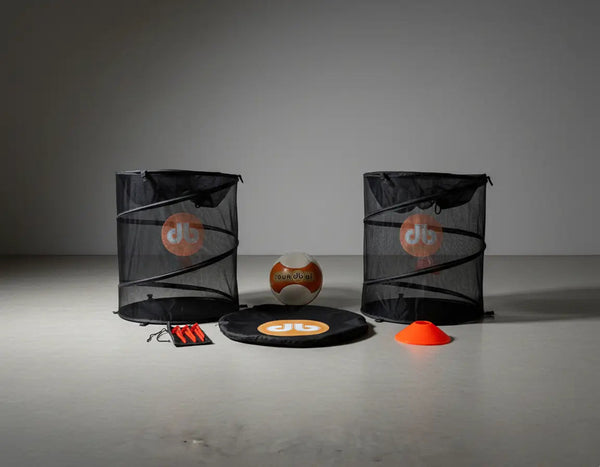
Equipment: RoundBol Game Set — includes two circular goals, ball, cones, stakes, and carry bag ($98)
RoundBol is a 360-degree soccer game built around two circular goals. Because the goals are round, you can score from any direction — behind, in front, either side. No "safe" positions. No standing around. Everyone's moving, everyone's involved.
Set up the two goals about 15–20 yards apart, lay down the cones to mark the pitch, and play. Two-on-two works great. Three-on-three is chaotic in the best way. Even one-on-one works if your kid wants to sharpen footwork and finishing.
The 360-degree scoring means kids naturally learn to think about angles, off-ball movement, and defending space — not just standing between the ball and the goal. It teaches real soccer concepts without anyone lecturing about "shape" or "positioning." The game just forces it. Skill floor is low enough for an 8-year-old. Ceiling is high enough for a travel player.
Check out the full RoundBol kit here →
4. Red Light, Green Light (with a Ball)
Ages: 4+
Players: 2–10
Equipment: One ball per player
You know the game. One person stands at the far end with their back turned. Everyone else lines up at the other end — but in this version, every player has a ball at their feet.
"Green light" — dribble forward. "Red light" — stop the ball dead. Ball still rolling when the caller turns around? Back to the start.
Simple, loud, surprisingly competitive. Little kids love it. The stop-and-start rhythm forces kids to keep the ball close and develop a soft touch — one of the best ways to teach ball control without calling it a "drill." Add "yellow light" for slow dribbling to make it harder.
5. Cone Dribbling Relay
Ages: 6+
Players: 2+ (works great as a race with 4–8)
Equipment: 6–10 cones (or water bottles, shoes, rocks — anything), one ball per team
Line up cones in a row about 3 feet apart. Split into two teams. First player dribbles through the cones and back, tags the next person, repeat. First team to finish wins.
It's a race and kids take races seriously.
Adjust it however you want: inside-of-foot only, left foot only, pull-back turn at the end. Time individual runs and let them try to beat their own record. What it builds: close control, both-footed dribbling, quick direction changes.
6. Soccer Tennis
Ages: 8+
Players: 2–4
Equipment: A low "net" (a rope between two chairs, a cooler, a line of cones) and one ball
Set up a net about 2–3 feet high across the middle of your playing area. A rope between two chairs works. A cooler works. Two players (or two teams of two) stand on either side. Serve the ball over with your foot. One bounce, up to three touches to send it back. Bounces twice or goes out? Other side scores. Play to 11.
A staple at professional training grounds — builds first touch, volleying, and reading the ball's flight. At home, it's just a fun rally with enough trash talk to keep everyone engaged. Allow two bounces for younger kids.
7. Crab Soccer
Ages: 5+
Players: 4–10
Equipment: One ball (a slightly deflated ball works best), cones for goals
Belly up, hands and feet on the ground, hips lifted. Now kick the ball while crab-walking. That's the whole concept and it's as ridiculous as it sounds.
Set up two small goals with cones, split into teams, and play. Nobody is good at this. That's the point. The kid who just started and the travel player are equally awkward. It levels the playing field like nothing else and doubles as a full-body workout.
Use a slightly deflated ball so it doesn't roll too fast. Keep the field small — 10 by 15 yards is plenty.
8. Monkey in the Middle
Ages: 5+
Players: 3+
Equipment: One ball
Two or more players pass the ball back and forth. One player stands in the middle and tries to intercept. Win the ball? The person who made the bad pass takes your spot.
Every kid already knows this game. What makes it legit soccer practice at home: passing accuracy, weight of pass, first touch, and movement off the ball all get worked on without anyone realizing they're "training." Add a touch limit for older kids — two-touch or one-touch only to make it intense.
9. Target Practice (Soccer H.O.R.S.E.)
Ages: 7+
Players: 2–4
Equipment: One ball, targets (cones, buckets, water bottles, trash cans — get creative)
Borrow the concept from basketball's H.O.R.S.E. and put it on the lawn. Set up targets around the yard — cones, buckets, whatever. Player one picks a target and takes a shot. Hit it, and everyone else has to match. Miss, you pick up a letter. Spell H.O.R.S.E. and you're out.
The fun is in the trick shots: weak foot only, chipped, curved around a chair. For younger kids, skip the letters — set up five targets, give everyone five shots, most hits wins.
What it builds: shooting from different angles, weak foot confidence, and the willingness to try something difficult.
10. Small-Sided Scrimmage (2v2 or 3v3)
Ages: 6+
Players: 4–6
Equipment: Cones for goals (or actual goals if you have them), one ball
Sometimes the best backyard soccer game is just... soccer. Small-sided scrimmages strip it to the essentials. Fewer players means more touches, more decisions, more goals.
For younger kids (6–8), set up about 15 by 20 yards with cone goals. Older kids, expand to 25 by 30. No goalkeepers — just outfield players and small goals. First to 5 wins.
If you've got a RoundBol set, this is where it really shines. The 360-degree goals mean there's no "parking the bus" in front of the net. Kids have to defend in space and attack from angles — which is exactly what coaches want to see at every level. No hiding on the wing. No standing in the back waiting for the ball.
The Real Point
You don't need a perfect setup. You don't need a membership or a subscription or a training app. You need a ball, some open grass, and a kid who's willing to go outside.
These soccer training games work because they don't feel like homework. They feel like playing. And playing is how kids actually get better — not by standing in a line waiting to do a drill, but by chasing a ball around the yard with someone they want to beat.
Start with whatever you've got. If that's just a ball and a wall, Monkey in the Middle and Red Light Green Light are free and they work. If you want to set up something more structured, a few cones and a RoundBol kit turn any backyard into a real pitch.
See you outside.
Want more backyard game ideas? Check out our guide to the best Spikeball alternatives for 2026, or grab the RoundBol Game Set and start playing today.
Keep Exploring
- Best Outdoor Games for Birthday Parties — Top picks for group events and celebrations
- Best Yard Games for Family Gatherings — Games every age group can actually enjoy
- The Best Spikeball Alternatives Worth Playing — Net games that go beyond the usual suspects
- How to Play RoundBol — Learn the rules in under 2 minutes
- Our Story — How RoundBol started on a Venice beach
- FAQ — Common questions answered
- Get the Kit — Everything you need to start playing