5 Ways to Play roundból
The thing about a “pitch” (grass, dirt or sand), a ball, and two round goals is that you can play almost anything on them. roundból ships with a quick-start guide with rules & field specs but the actual game is more flexible than the guide suggests.
This is a tour of five real ways to play. The original. The 3v3 most people end up settling on. The beach tournament setup. The version that works with the eight-year-old. And the loose party variant where the rules drift halfway through and nobody minds.
Pick your mode. Or rotate through all of them in a single afternoon. The kit is the same.
Mode 1: Free Play (the Original)
How it works: Two goals 36 yards apart per the rules card, or fit to your space. One ball. As many players as the yard fits. No teams, no shifts, no scoreboard. The first version of roundból, played the way kids invent backyard games — pickup style, attacking either goal, running around until someone's hungry.
Best for: First time out of the bag. Younger kids who haven't locked into a competitive format yet. Cul-de-sacs, beach, parks, anywhere a friend wanders over and asks to join in.
Why it's fun: Free play is roundból at its most honest. The 360-degree goals reward angles and movement instead of brute force, and without teams, every kid is on offense and defense at the same time. Nobody parks. Nobody hides. It's the mode that turns into pickup soccer the second you stop refereeing it.
Mode 2: Teams of 3
How it works: Two trios, two goals, one ball. Each team picks a goal to defend. Pass with your feet, strike your opponent's goal from any angle for one point, or get the ball into the goal for two points. First team to a target score wins. Most families settle on first to 7 or first to 11. Games usually run 15-20 minutes.
Best for: Soccer families with a full crew. End-of-season team parties. Mixed-age cookouts where six players want to be on the field at once. The format roundból was tuned for from the start.
Why it's fun: 3v3 is the sweet spot of the game, and once a household plays a few rounds, it's the format that sticks. Six players on the pitch means real movement off the ball — give-and-go passes, screens, drifting to the back side of the goal to bait a defender out of position. It's the format competitive players gravitate toward; the skill ceiling is real, even though the floor is "kick a ball." It's the same mode pickup soccer kids find without anyone teaching it.
Mode 3: Beach Tournament
How it works: Stake the goals into hard-packed sand, or weight the goals by placing a heavier object inside. Set up the field according to the spec sheet and run a bracket. Four teams of three play matches to 3, 5 or 7 points. Winners advance, losers play in a consolation bracket. Whoever stands at the end gets the cooler.
Best for: Beach trips. Family reunions where there's a stretch of flat sand. Vacation weeks where someone has to organize the afternoon and "we're running a roundból tournament" is the magic phrase.
Why it's fun: Beach turns the game into a workout. The sand drains energy fast, so shorter matches feel like a full game's worth of running. The compact pitch keeps the action close — every touch matters when there's only 18 yards between goals. A four-team bracket wraps in under an hour. Bring sunscreen.
Mode 4: Family Game with Kids (Modified Rules)
How it works: Goals 15-20 yards apart. Younger kids on one team with a parent or older sibling. House rules: no slide tackles, no close contact, score only counts if the youngest player on the team has touched the ball in the last three passes. That last rule sounds gimmicky and yet works wonders.
Best for: Mixed-age games where younger siblings want to join. Family gatherings where the cousin spread spans 6 to 16. The first 20 minutes of any party where kids are still warming up.
Why it's fun: The "youngest must touch" rule is the thing. It forces older players to set up the younger ones instead of dribbling around them, and the youngest on the team becomes the most important shooter on the field. Kids feel it instantly. Parents end up working harder than the kids, and the kids end up scoring more than anyone.
Mode 5: The Party Variant (Rules-as-You-Go)
How it works: Set up the goals. Pick teams (or don't). Score by striking or getting the ball into a goal, with whatever rules the group agrees on while a drink is in someone's hand. No keeper. No formal score. The game ends when the food's ready or the sun's gone or somebody calls it. Common variants: kids get to move while parents stay in a spot, every goal celebrated by the scorer doing something stupid, penalty kick from mid-field by a kid if a parent shoots too hard. Bottom line is to make it up as you go along and just have fun!
Best for: Backyard parties with kids and adults. Graduation parties. The post-cookout slot when everyone's full and somebody suggests "let's actually play something." Weekend barbecues that need a centerpiece activity that doesn't take a tournament organizer.
Why it's fun: The party variant is the format that makes roundból a game adults will play, not just supervise. The 3v3 structure and quick scoring means rotating in and out is easy — three minutes on, three minutes off, plenty of time to refill a drink. Skill doesn't matter, age range doesn't matter, and the stakes stay low.
Pick One. Or All of Them.
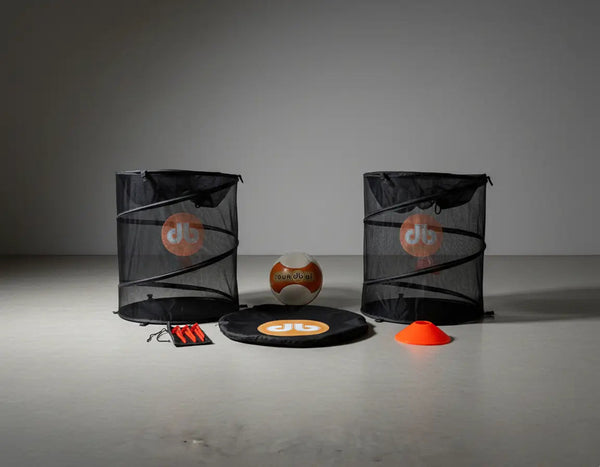
The game kit is the same across every mode. Two collapsible round goals. One ball. Cones to mark the pitch. Stakes to anchor the goals. A quick-start guide. Setup runs three minutes. Most yards work. The beach works. The cul-de-sac works.
Free play for the first run-out. 3v3 once a household locks in. Beach tournaments on vacation. Family rules with the younger kids. The loose party variant for adult cookouts. Five modes from one set, and kids tend to invent a sixth before the first month is out — that part's not on us.
Get the roundból kit → — $98, ships flat, plays five different ways.
See you outside.