Lawn Games for Graduation Parties: How to Pick One Everyone Plays
Graduation parties have a guest list problem. The grad invites their friends. The parents invite the cousins, the neighbors, the aunt who flew in, and the grandparents. By the time everyone shows up at 1 p.m., you've got a yard full of people aged 6 to 86, and the only thing they have in common is the cake.
That's why the lawn games matter. Food keeps people busy for forty minutes. Conversations cover another hour. The stretch between 2 and 5 p.m. is where most graduation parties stall, and the right backyard game is the difference between guests checking their phones and a yard full of laughing.
This guide is written for the host setting up the yard, not the grad or the gift-shopper. The parent or grandparent who needs gear that works for the eight-year-old, the seventeen-year-old, and the great-uncle who sits in a chair the whole time. We pulled five honest picks across price points, plus a short list of games that sound great on Pinterest and stall in real life.
The average host budgets around $1,128 for a 60-person graduation party (roughly $19 per guest) according to a 2026 hosting cost breakdown. The right lawn game is somewhere between $40 and $120 of that. Small money for the part of the party people actually remember.
What to Look For in a Graduation Party Lawn Game
Before the picks, four filters that separate gear that works from gear that sits in the corner.
Mixed-age range. A graduation party isn't a tailgate. The eight-year-old cousin and the seventy-year-old grandma both need to participate, or the game splits the group instead of bringing it together. Anything with a steep skill curve gets retired by 3 p.m.
Set-up time under five minutes. You're already running food, drinks, photos, and a slideshow. A game that needs ten minutes of assembly and a measuring tape is going on the porch and staying there. Set up should be one person, one trip from the garage.
Weather flex. May graduation parties get rain. Boulder, in particular, has a habit of dropping a 4 p.m. afternoon shower on otherwise sunny weeks. A game that survives wet grass, or packs up fast and moves to a covered patio, is a game you can plan around. Anything that requires a perfectly mowed dry lawn is a liability.
Price under $150 for a real version. Cheap sets warp, rust, and unravel inside a season. The honest range for gear that lasts past the party and into the summer is $40 to $150. Anything north of that is a hobby investment, not a graduation-party purchase.
Five Lawn Games That Actually Work for Graduation Parties
1. Cornhole
Price range: $50 to $150 | Players: 2 to 4 | Best for: the default game at any party
The default for a reason. Two boards 27 feet apart, eight bean bags, score by tossing into the hole or onto the board. Grandparents play it sitting down. Eight-year-olds play it standing on the deck. Teenagers get competitive about it. It's the only lawn game with that range built in.
Set-up is under two minutes. Pull boards from the garage, drop them on the lawn, hand bags to the first players.
The catch: the cheap $40 sets warp inside one summer. Spend $80 to $150 for plywood boards with regulation dimensions.
2. Bocce
Price range: $50 to $100 | Players: 2 to 8 | Best for: the conversational game of the afternoon
The most underrated lawn game on this list. Eight balls, one small target ball (the pallino), roll your ball as close to the pallino as possible. That's the whole game. Toddlers can play it. Great-grandparents can play it from a chair. The skill ceiling is real for anyone who wants to compete, but the floor is "roll a ball gently."
Set-up is under one minute. Open the case, hand out balls, throw the pallino.
The catch: you need about 30 feet of relatively flat ground. Steep yards or fully sloped lawns make it frustrating. Heavy balls also mean kids under five need supervision; a dropped bocce ball on a foot is a real problem.
3. Giant Jenga (Tumble Tower)
Price range: $40 to $80 | Players: 2 to 10+ | Best for: patio and porch crowds
Fifty-four oversized wooden blocks stacked into a tower. Pull one out, stack it on top, don't let it fall. The tension keeps a crowd watching. The crash is what people text each other about that night.
Set-up is about three minutes for a careful first stack. After that, every game starts in under thirty seconds.
The catch: the tower needs a flat hard surface like a deck, patio, or driveway. Set it on grass and the third turn knocks it over. If your party is fully on the lawn, this one's not your pick.
4. roundból
Price: $98 | Players: 2 to 8 | Best for: parties with the grad's friends or a soccer player in the family
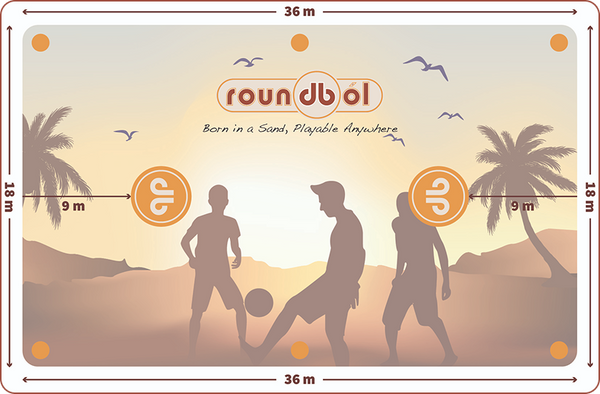
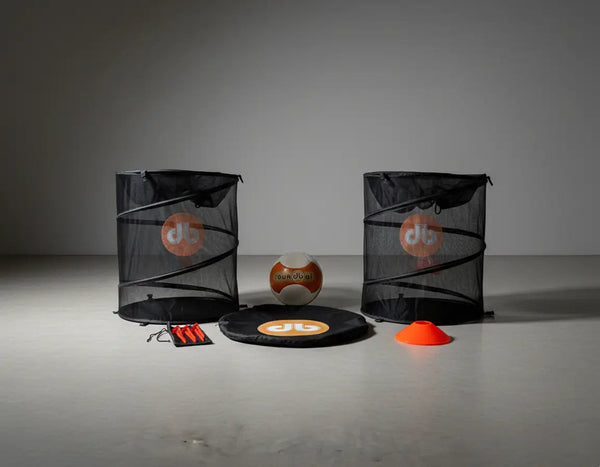
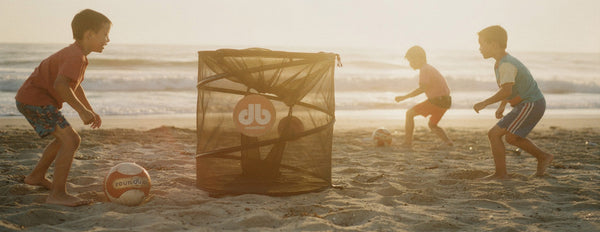
A backyard soccer game with two collapsible round goals, a ball, cones, and stakes. It sets up in three minutes. The goals are round, and the game plays 360 degrees — score from any angle, no goalie, no standing around, no waiting for a turn.
Set-up is about three minutes total. Stake the goals, drop the cones, kick off.
Why it works at a graduation party: roundból fits the part of the afternoon a graduation party usually misses, when the grad's friends want to move and not just stand on the lawn drinking lemonade. The skill floor is low (if you can kick a ball, you can play), the depth is there for the soccer kid, and at 3v3 the game stays interesting even with mixed ages.
The catch: you need a chunk of relatively flat yard. If your space is a small patio, this isn't the one. And the play pace is athletic; younger kids under eight may step out after fifteen minutes.
The full game set is $98. Fits in a normal trunk and stays there for the rest of the summer.
5. Spikeball or a Spikeball-Style Net Game
Price range: $75 to $120 | Players: 4 (2v2) | Best for: parties heavy on the grad's friends
A trampoline-style net on the ground, a ball, three touches per side, no boundaries. Fast and athletic. Fun for the right crowd.
Set-up takes five minutes for a first-time host, two minutes after that.
The catch: Spikeball is a real sport. Four players, real reflexes, and younger kids and older guests aren't playing this with the high schoolers. If your guest list skews young and athletic, it's a hit. If it skews mixed-age across three generations, half the yard ends up watching.
What NOT to Bring to a Graduation Party
Pinterest will recommend these. They sound great. They will not get played.
- Lawn charades or "school memory" prompts. Cute on paper. In practice, the grad's friends won't volunteer and the prompt cards end up in the recycling.
- Water balloon fights. Half your guests are dressed up; the grandparents are in chairs. This is how you end the afternoon early.
- DIY ring toss with traffic cones. The DIY version of a real game is always worse than the real game. Buy a ladder toss set for $40.
- Trivia about the grad. Works for ten minutes at the family table. Doesn't work as a lawn game with thirty people.
- Anything with a 30-page rulebook. If teaching takes more than 60 seconds, the game loses half the players in the explanation.
The good lawn games are the ones a guest can join mid-stream by walking up and taking a turn. Games that require setup, attention, or rule-reading don't compete with food and conversation.
Graduation-Party-Specific Setup Notes
A few practical details if your graduation party is in May.
Plan for one weather pivot. May graduation weekends, including CU Boulder's May 1–3 commencement window, see afternoon thunderstorms more weeks than not. Pick games that pack up fast. Cornhole, bocce, and roundból all break down in under three minutes. Giant Jenga and Spikeball can move to a covered patio. Have one indoor backup for the worst-case rain hour: a card game, dominoes, or the slideshow on a longer loop.
Set up before guests arrive. Games staged at 12:45 for a 1 p.m. party get used. Games unboxed at 2:30 because someone asked don't. The five-minute pre-party walkthrough is the difference.
Stage games away from the food zone. Stadium chairs and bean bags don't mix with deviled eggs. Put the games on one side of the yard and the food on the other. The split keeps the food line moving and the games visible from the patio.
One game running at a time. Two simultaneous games splits a 30-person crowd into thin groups of six. Cornhole going from 1 to 2:30, bocce from 2:30 to 4, Spikeball or roundból from 4 to whenever the parents leave. The games rotate; the crowd doesn't have to choose.
A Quick Picker (By Crowd)
| Crowd | Pick | Why |
|---|---|---|
| Three generations, mixed ages | Cornhole + bocce | Both work for kids, parents, and grandparents simultaneously |
| Heavy on grad's friends | roundból + Spikeball | Athletic energy gets used; 3v3 is the sweet spot |
| Tight yard / patio party | Giant Jenga + bocce | Both work on smaller flat spaces |
| Budget under $100 | Cornhole ($80 set) + bocce ($30 set) | Two games covers every guest type |
| Budget $100 to $200 | Cornhole + roundból | One default plus one differentiator |
Frequently Asked Questions
How many lawn games should you have at a graduation party?
Two is the right number. One game running for the conversational crowd (cornhole or bocce), one game running for the active crowd (roundból, Spikeball, or giant Jenga). Three games splits a 30-person party too thin; one game leaves half the guests waiting for a turn. Stage them at opposite sides of the yard and rotate which one is "on" through the afternoon.
What's the best lawn game for a graduation party with mostly older relatives?
Bocce is the clear pick. The skill required is "roll a ball gently," which works from a chair if needed. Cornhole is the close second; also playable from a chair, though it asks for slightly more arm strength. Skip anything with a steep curve (Spikeball, ladder toss) when the median guest age is over 50.
Can lawn games work for a graduation party with limited yard space?
Yes. Pick games designed for tight spaces. Giant Jenga works on a 6-by-6-foot flat surface. Bocce works on any 25-foot stretch. Cornhole needs about 30 feet end-to-end but can run along a driveway. Save the wider games (roundból, Spikeball, badminton) for parties on a full lawn or a nearby park.
How early should you set up the lawn games?
Stage everything 15 minutes before guests arrive. Boards out, bags handy, balls at the ready. Games unboxed mid-party tend to stay unboxed. The pre-arrival walkthrough is the cheapest way to make sure the gear gets used.
The Real Move
The best lawn games for graduation parties are the ones a 12-year-old cousin and a 70-year-old grandparent can both join without a teaching session. Cornhole and bocce are the safest defaults because they work for everyone. roundból earns its slot if there's an athletic crowd or a soccer player in the family. Skip the DIY Pinterest ideas and the trivia games. Neither survives a real party.
Pick two. Stage them before guests arrive. Rotate through the afternoon. That's the whole playbook.
If you've got a soccer-leaning crowd in the mix, the roundból game set is $98. Two collapsible round goals, a ball, cones, stakes, and the quick-start guide. Sets up in three minutes, and stays in the trunk for the rest of the graduation-and-Memorial-Day-and-July-4th run.
Whatever you pick: pick something the cousins can actually play together.